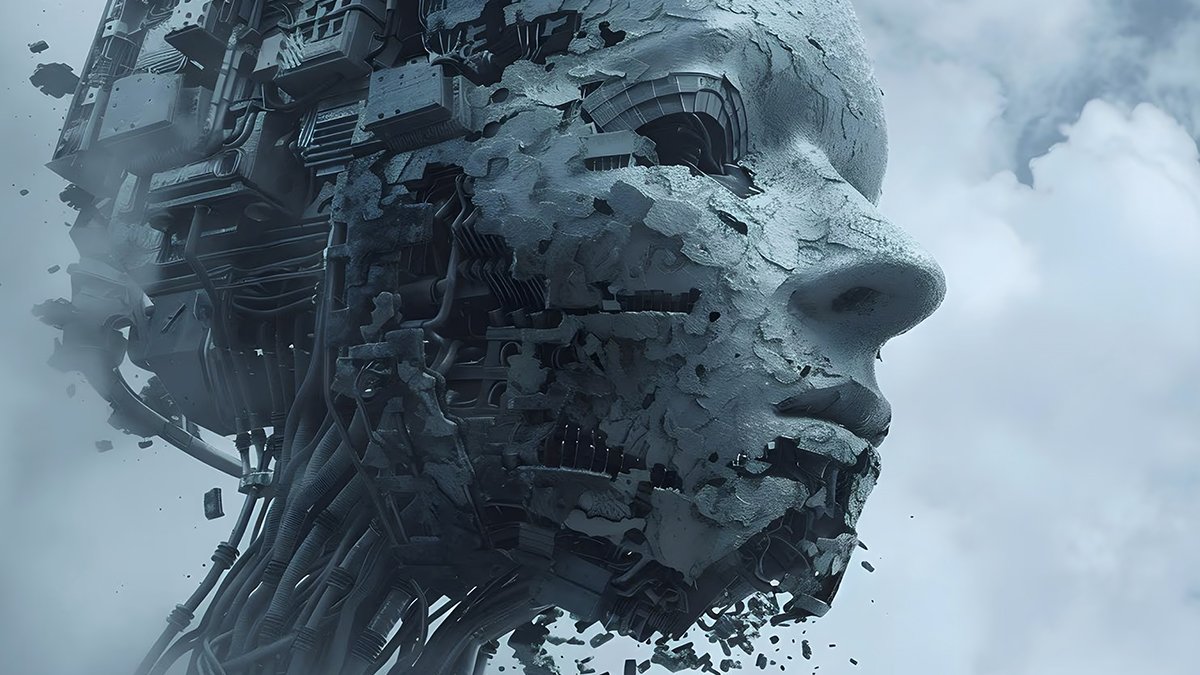
The anxiety around AI is easy to understand. It is being discussed as a force that will eliminate roles, flatten industries, and make whole categories of work obsolete. None of that fear is irrational. But it may still be the wrong frame.
The more uncomfortable possibility is that AI is not introducing something entirely new. In many environments, it is exposing what had already happened. Work in large systems has been shaped for years by standardisation, scripting, throughput targets, and process discipline. In too many places, people have been expected to behave like machines long before machines became capable of behaving like people.
Seen through that lens, AI is not just a disruption story. It may be a correction. Not because human contribution matters less, but because the arrival of AI forces a harder question: what work actually requires a human, and what work only existed because the system had no better way to scale?
When efficiency becomes the product.
Healthcare makes the problem easy to see. As systems scale, consultations shorten, interactions become more standardised, and institutional pressure shifts toward volume, compliance, and throughput. The centre of gravity moves away from the person in front of you and toward the process wrapped around them.
This is not primarily a moral failure of doctors, nurses, administrators, or practitioners. Most people enter these professions because they care. It is a structural outcome. When systems are built to optimise measurable efficiency, they gradually squeeze out what is harder to measure: time, attentiveness, judgment, explanation, and emotional presence.
This is part of the irony in the current AI debate. One of the loudest objections to AI is that it feels robotic. Yet many people already experience large institutions through scripted language, standardised pathways, and functionally mechanical interactions delivered by humans working inside highly constrained systems.
The fear is that AI will make work robotic. In many sectors, the system had already been pushing people in that direction.
What AI actually compresses.
AI does more than automate tasks. It compresses time, and time sits underneath cost in almost every knowledge-intensive industry. Research, triage, summarisation, first-pass analysis, monitoring, coordination, drafting, and pattern detection all become faster when intelligence can be distributed instantly.
In healthcare, that matters because the current model depends on long training cycles, scarce expertise, and expensive capacity. Scarcity drives cost. Cost restricts access. Restricted access reinforces inequality. AI begins to loosen that chain by making foundational knowledge and first-layer support far more available.
That does not remove the need for trained professionals. It changes where their time is most valuable. High-stakes decisions, ambiguity, emotional context, exceptions, and complex judgment still require a human in the loop. The shift is not from human to machine. It is from human effort spent on routine process to human effort reserved for what genuinely needs discernment.
The deeper shift is from reactive to proactive.
Traditional service models are mostly reactive. Something breaks, someone notices, an intervention begins. In healthcare that often means symptoms first, testing second, treatment third. In other industries it looks similar: the issue appears, the team scrambles, the process starts after the problem is already expensive.
AI enables a different architecture. Continuous monitoring, pattern recognition, predictive alerts, and personalised guidance move the model earlier. The question shifts from “what is wrong?” to “what can be detected, prevented, or improved before failure compounds?”
This is where the opportunity becomes much larger than productivity alone. The organisations that use AI to make their systems more anticipatory, more personalised, and more responsive will not simply operate faster. They will become more valuable to the people they serve.
The long-term prize is not just doing the same work faster. It is redesigning the system so fewer preventable problems happen in the first place.
What disappears, and what becomes more valuable.
It is worth being precise here. AI is strongest where work is repetitive, process-heavy, high-volume, and pattern-based. It performs well when consistency matters more than context, when response structures repeat, and when the objective is speed with acceptable accuracy at scale.
What becomes more valuable as a result is everything that does not compress cleanly: judgment where context changes the answer, empathy where trust affects the outcome, creativity where the unexpected matters, and leadership where trade-offs must be made in the presence of uncertainty. These are not soft edges around the real work. They increasingly become the real work.
This is why the future of professional value will not be defined by who can repeat the process fastest. AI will win that contest. The enduring advantage will sit with people and organisations that know where human presence changes the quality of the result.
Why this moment looks more like a reset than a replacement.
For decades, modern organisations have been rewarded for scale, efficiency, and throughput. AI will outperform humans on those dimensions almost everywhere. Competing with AI on those terms is not a durable strategy. But that does not leave people with less to contribute. It forces a better allocation of contribution.
In that sense, AI may be resetting the boundary between necessary work and meaningful work. It strips away some of the labour that systems needed in order to function at volume, and in doing so exposes what should have remained central all along: judgment, care, imagination, trust, accountability, and the ability to navigate context rather than merely process it.
The business question is not whether AI will change your industry. It already is. The more strategic question is whether you will use that pressure to reallocate human effort toward higher-value contribution, or whether you will keep defending work that was only ever necessary because the system was inefficient.
AI does not only ask what can be automated. It asks what human effort was truly for in the first place.
Where Veloryn fits in.
At Veloryn, this is how we think about implementation. Not automation for its own sake, and not AI as decoration around an unchanged operating model. The objective is to remove work that is repetitive, slow, and structurally misallocated, so people can focus on what strengthens the business and improves outcomes.
The organisations that benefit most are rarely trying to remove humans from the picture. They are trying to remove avoidable friction, compress dead time, improve decision quality, and build systems where human effort is applied where it matters most. That is a very different ambition from replacement, and a far more valuable one.
Final thought.
AI will displace certain tasks. That part is real. But the more consequential story may be what it reveals about the systems we had already built around work, service, and expertise. In many cases, the machine is not arriving to make work less human. It is arriving to show us how much of it already was.
That is why this moment should not be read only as a threat. It should also be read as an opportunity to rebuild around a clearer principle: let systems handle what is mechanical, and let people do the work that only people can do well.
That is not the end of human value. It may be the beginning of restoring it.
The most valuable use of AI may be forcing organisations to become more human where it actually counts.