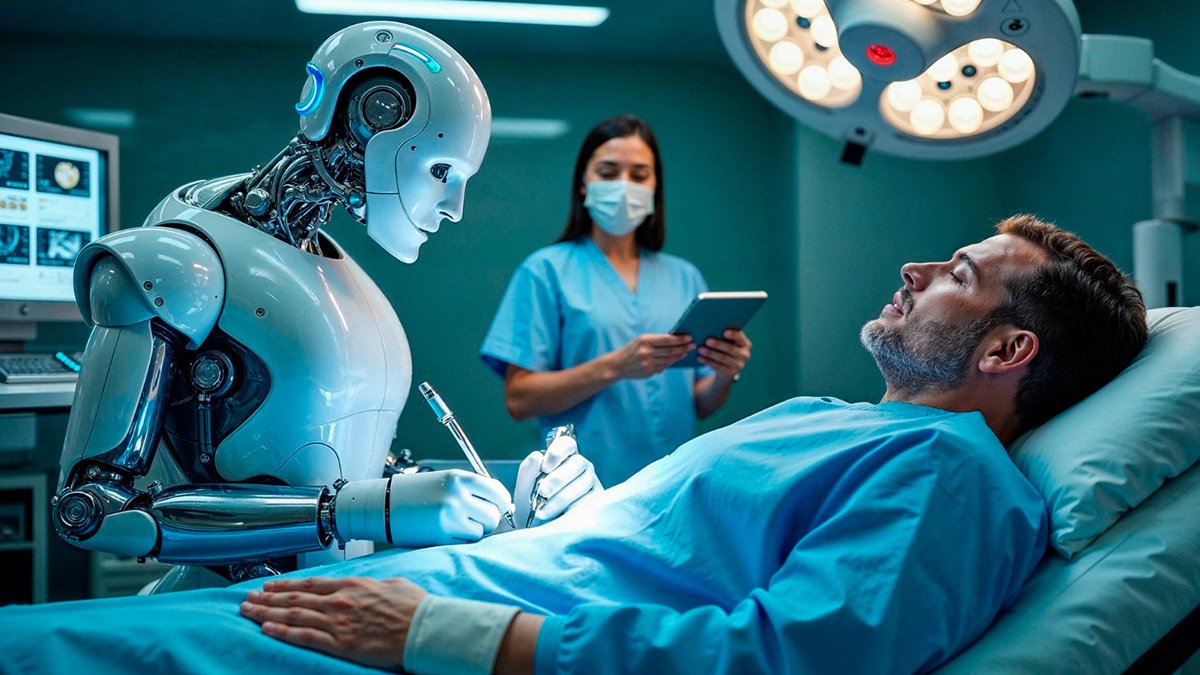
Healthcare is one of the most advanced sectors in the world, yet one of its most serious problems remains easy to underestimate: diagnosis. Every year, patients suffer because the right condition is not identified early enough, or because critical information is missed under pressure.
Recent estimates cited in the healthcare debate suggest that diagnostic errors contribute to approximately 371,000 deaths and 424,000 permanent disabilities each year in the United States. The financial cost is also significant, with misdiagnosis estimated to cost the U.S. healthcare system roughly $100 billion annually through unnecessary testing, prolonged hospital stays, readmissions, complications, and malpractice expenses.
Those figures do not point to a simple failure of doctors. They point to the complexity of modern medicine. The central question is whether clinicians can be given better tools to manage that complexity.
The strongest case for medical AI is not machine versus doctor. It is doctor plus better intelligence at the point of care.
The problem is complexity, not intelligence
Modern physicians operate inside an information environment no individual can fully hold in their head. Diseases overlap. Symptoms can be vague. Rare conditions can look like common ones. Research changes quickly. Guidelines evolve. Patient histories are long, fragmented, and often buried across multiple systems.
At the same time, doctors work under severe time pressure. They must interpret laboratory results, imaging, medication histories, prior admissions, patient notes, family concerns, and administrative requirements while managing real human anxiety in front of them.
Most diagnostic errors do not happen because doctors lack intelligence or care. They happen because medicine is difficult and human cognition has limits.
AI should not replace physicians
The fear surrounding AI in healthcare is understandable. Patients do not want a machine making life-and-death decisions without accountability. They want trust, empathy, judgement, and a human professional who understands the person behind the condition.
Those capabilities remain deeply human. AI cannot comfort a frightened patient, understand family dynamics, build trust across years of care, or replace the moral responsibility carried by a clinician.
But AI can support the physician. It can review large volumes of information quickly, identify patterns that deserve attention, surface overlooked details, and suggest possibilities for human evaluation. In that role, AI becomes a clinical co-pilot rather than a replacement.
Medicine has always advanced through better tools
The medical profession already depends on technology. X-rays, CT scanners, MRIs, blood analyzers, ultrasound, electronic medical records, and surgical tools did not remove physicians from care. They expanded what physicians could see, measure, and decide.
AI belongs in that same category when deployed responsibly. It should not be treated as an autonomous doctor. It should be treated as a decision-support layer that strengthens clinical judgement by making relevant information easier to see.
The physician remains in command. The physician evaluates the recommendation. The physician makes the final decision. The physician remains accountable to the patient.
How an AI clinical co-pilot could work
Consider a patient arriving at an emergency department with fatigue, chest discomfort, and shortness of breath. The symptoms could point to several conditions, including pneumonia, heart failure, pulmonary embolism, anxiety, coronary artery disease, anemia, infection, or other causes.
A busy clinician must assess the patient while managing other cases. An AI system working in support could review the medical history, laboratory values, medication records, imaging, previous admissions, similar cases, and current clinical guidance within seconds.
The system might flag a possible pulmonary embolism based on risk factors. It might highlight a recent medication change. It might detect patterns consistent with early sepsis. Some suggestions would be dismissed by the doctor. Others might trigger a crucial second look.
That is the value. AI does not need to be perfect to be useful. It needs to reduce the chance that an important clue is missed.
Even small improvements would matter
Medicine will never eliminate uncertainty. Humans are imperfect, and technology is imperfect. The goal is not perfection. The goal is measurable improvement.
If AI-assisted decision support reduced diagnostic errors by even a modest percentage, the effect at scale could be significant. Fewer missed diagnoses would mean fewer deaths, fewer permanent disabilities, shorter hospital stays, lower costs, and better outcomes for patients and families.
This is why the healthcare AI debate should not be reduced to replacement. The more urgent question is whether responsible systems can help clinicians make better decisions when the stakes are high.
AI can also reduce pressure on doctors
The benefits may extend beyond diagnosis. Physician burnout has become a major issue as administrative work grows. Many clinicians spend large portions of their time documenting visits, reviewing records, completing forms, and catching up on charts after patient hours.
AI can help by summarising patient histories, drafting documentation, organising notes, preparing handovers, and surfacing relevant records. Done properly, this allows doctors to spend more time on care and less time on clerical burden.
In that sense, medical AI can protect both patients and physicians. It can support safer decisions while reducing some of the operational pressure that makes clinical work harder.
Trust must remain central
Healthcare AI must be held to a high standard. Patient privacy, clinical validation, bias testing, transparency, security, and human oversight are not optional. A black box system making unchecked recommendations would create serious risk.
The safest direction is clear. AI outputs should remain recommendations. Clinicians should be able to understand, question, accept, or reject them. Organisations should maintain audit trails, governance rules, and clear accountability.
The objective is not automation for its own sake. The objective is better medicine.
The future is human plus AI
The history of technology in professional work shows a consistent pattern. The strongest tools amplify human capability. Power tools did not replace builders. Spreadsheets did not replace accountants. Imaging systems did not replace doctors.
AI is likely to follow the same pattern in healthcare if it is deployed responsibly. Doctors equipped with intelligent support may be able to identify risks earlier, manage information more effectively, reduce administrative overload, and make better decisions.
AI will never replace the physician sitting beside the patient. But it may help that physician save more lives.
Behind every diagnostic statistic is a person whose life might have changed if the right diagnosis had been reached sooner. That is why the most important healthcare AI question is not whether machines should replace doctors. They should not.
The better question is how quickly and responsibly healthcare systems can give doctors tools that help them see more, miss less, and care better.