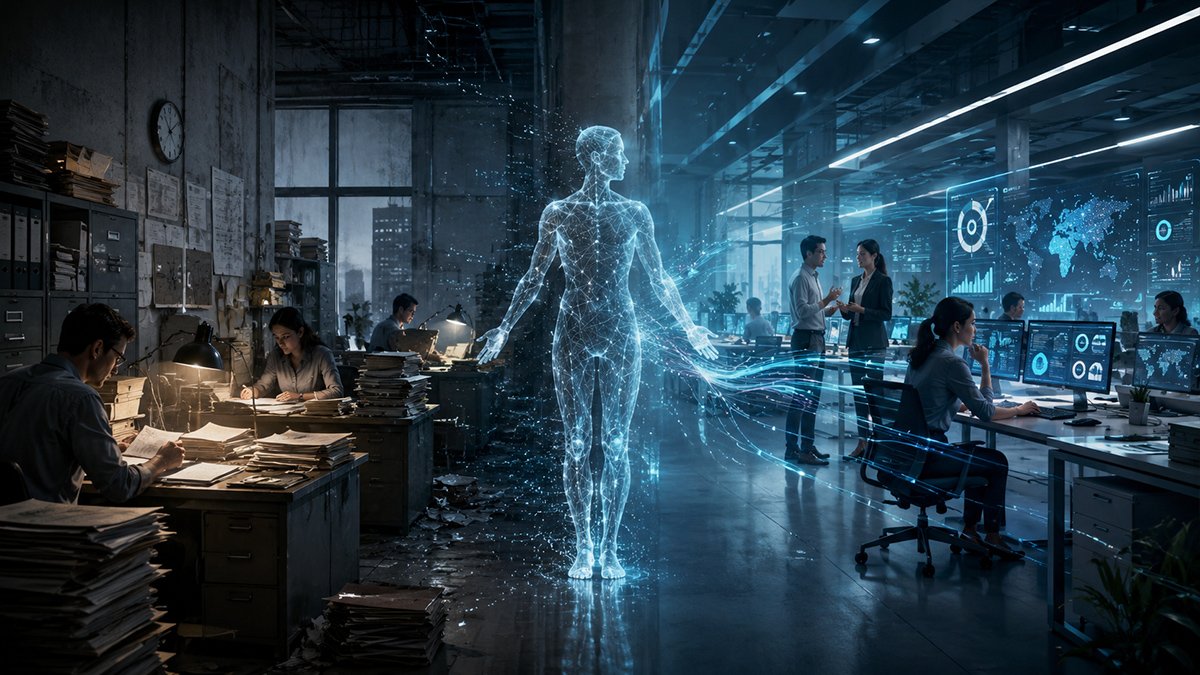
“You want to protect the world, but you don’t want it to change.”
It is one of the coldest lines in the Marvel universe. Not because Ultron was entirely right. But because the quote exposed a contradiction humanity constantly struggles with: we want progress without disruption, innovation without discomfort, and a better future without changing the systems that created the present.
And nowhere is that contradiction more visible today than in the global conversation around AI and the job market.
Everyone wants AI benefits. Few want AI consequences.
Companies want productivity gains. Consumers want faster services. Investors want explosive growth. Governments want technological leadership. Employees want less repetitive work.
But at the same time, many people expect the labour market itself to remain mostly untouched. That expectation is unrealistic.
AI is not arriving as a tool upgrade. It is arriving as a structural shift in how human value is created. That distinction matters because history shows that when a technology fundamentally changes the economics of work, entire categories of jobs evolve, shrink, or disappear.
And AI is moving faster than most previous technological revolutions.
This has happened before, just not at this speed.
The fear surrounding AI often sounds unprecedented. But the pattern itself is not new.
When factories adopted industrial machinery, millions feared manufacturing jobs would vanish forever. When computers entered offices, administrative work changed permanently. When the internet became mainstream, countless industries were disrupted:
- travel agencies
- newspapers
- retail stores
- music distribution
- customer support
Every technological leap eliminated certain forms of work. But it also created entirely new industries that people previously could not imagine.
The internet destroyed some jobs. It also created:
- digital marketing
- app development
- e-commerce
- social media management
- cybersecurity
- creator economies
- SaaS businesses
- remote work ecosystems
The problem is that transition periods are painful. And AI is compressing the transition timeline dramatically. What previously took decades may now happen within years. Or months.
AI is not replacing humans. It is replacing repetition.
This is the part many discussions miss. AI is not primarily targeting humanity. It is targeting repetitive cognitive labour.
That includes work like:
- summarising documents
- writing first drafts
- processing data
- creating reports
- scheduling
- customer inquiries
- basic coding
- research synthesis
- standardised communication
For decades, many white-collar jobs were protected simply because human cognition was difficult to scale. Now, large language models can perform portions of that work instantly. That changes the economics of labour.
A marketing team that once needed 15 people may only need 5 highly AI-leveraged operators. A junior analyst role may evolve because AI handles much of the preparation work. A software engineer may produce 3x more output with AI-assisted development tools.
The value is shifting from execution speed to judgement, creativity, strategy, taste, and adaptability. That is the real disruption.
The uncomfortable truth nobody wants to say out loud.
Many jobs today exist because information processing used to be expensive. AI makes information processing dramatically cheaper.
That does not mean humans become useless. But it does mean some forms of labour become less economically valuable. And society struggles emotionally whenever that happens.
Because jobs are not just income. They are identity. Routine. Status. Security. Purpose.
When people fear AI, they are often not simply afraid of technology. They are afraid of becoming irrelevant. That fear is deeply human. And dismissing it as irrational is a mistake.
The workforce is splitting into two groups.
Right now, we are witnessing the early stages of a major divide. Not between technical and non-technical people, but between adaptable and non-adaptable people.
There are workers using AI to multiply their value:
- writers producing faster
- designers prototyping instantly
- consultants automating research
- developers accelerating workflows
- entrepreneurs operating leaner than ever before
Then there are workers pretending AI is temporary hype. History is usually unforgiving to the second group.
Because technological shifts rarely wait for consensus. The printing press did not wait for scribes to feel comfortable. The internet did not wait for newspapers to adapt. AI will not pause while industries debate ethics panels for the next decade.
The market moves first. Society reacts later.
The real danger is refusing to evolve.
There is a dangerous assumption hidden inside many anti-AI conversations: if AI changes work, then something is fundamentally wrong with AI.
But work has never been static. For most of human history, survival required physical labour. Then industrial economies rewarded mechanical efficiency. Then knowledge economies rewarded information access. Now AI economies reward leverage.
The definition of valuable work keeps changing. Always has. Always will.
The real danger is not that AI evolves. The real danger is that humans refuse to evolve alongside it. Because adaptation has always been civilisation’s greatest survival skill. Not comfort.
The future belongs to fast learners.
In previous generations, expertise alone could sustain an entire career. Today, knowledge has a shorter shelf life.
The modern economy increasingly rewards:
- learning speed
- flexibility
- interdisciplinary thinking
- communication
- creativity
- emotional intelligence
- systems thinking
- adaptability under uncertainty
Ironically, many of the most human skills are becoming more valuable precisely because AI is automating mechanical cognition.
When AI can generate information instantly, people who can interpret, prioritise, connect, and strategically apply information become disproportionately valuable.
That is why the future workforce may look smaller in some areas, but more amplified in others. One person with AI assistance can now perform work that previously required entire teams.
This creates enormous opportunity for adaptable individuals. And enormous anxiety for rigid systems.
We are entering the era of amplified humans.
The most successful people in the AI era may not be those with the highest IQs, the most degrees, or the longest resumes.
They may simply be the people most willing to adapt. The people willing to experiment constantly, learn publicly, reinvent themselves, abandon outdated workflows, and collaborate with AI instead of competing against it.
AI is not just a replacement technology. It is an amplification technology. It magnifies leverage. And leverage changes everything.
So, was Ultron right?
Not entirely. Humanity should absolutely question how AI develops. Ethics matter. Regulation matters. Responsible deployment matters.
But the quote still exposes an uncomfortable truth: many people want the rewards of progress without accepting the cost of transformation.
That has never been how history works. Every major leap forward disrupted something old. The challenge is not stopping evolution. The challenge is guiding it responsibly while preparing people to survive within it.
Because the future of work is not a battle between humans and AI. It is a battle between adaptation and stagnation.
And history usually chooses adaptation. Every time.